CMMS vs WhatsApp for Maintenance Management
Compare WhatsApp’s communication speed with CMMS work orders, asset history and accountability, then design a controlled hybrid model.
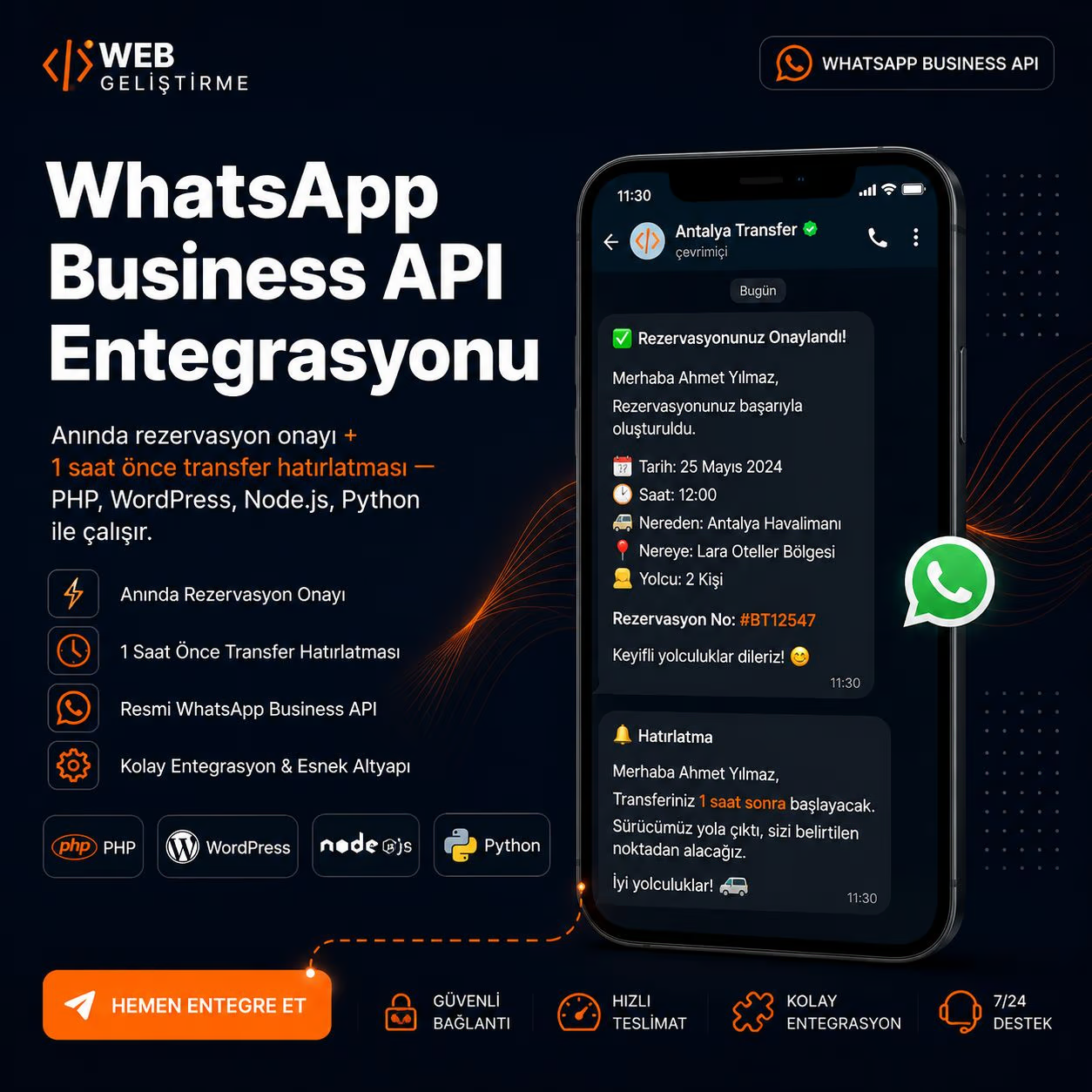
WhatsApp gives a maintenance team a fast channel for reporting problems and sending photos. A CMMS converts a report into an identified work order, links it to an asset, assigns ownership and status, and records duration and closure evidence. With WhatsApp alone, jobs can disappear in chat, the same fault may be reported repeatedly and dependable asset history does not form. A CMMS-only approach that ignores urgent communication can also reduce field adoption. The balanced model uses WhatsApp as a controlled intake or notification channel and the CMMS as the single official record. Every integrated message must be validated, linked to the correct work item and kept free of unnecessary sensitive data.
A CMMS is the source of truth for work orders and asset history. WhatsApp is a communication channel. In an integration, the channel passes an event into the system; job state is read from the CMMS record, not inferred from chat.
The tools solve different problems
WhatsApp is accessible and fast. Staff can send a message, photo or location to a familiar number. A CMMS instead stores asset, priority, owner, work step, part, duration and closure in defined fields. The US Department of Energy describes CMMS as software supporting the management and tracking of maintenance activities. O&M Best Practices Guide
Limits of WhatsApp-only management
Work identity becomes ambiguous
When three people message about one AC unit, it may be unclear whether there is one incident or three. A reply does not prove completion.
Status and ownership remain in conversation
“Ahmet will check” can disappear under new messages. Open work is reconstructed manually at shift handover. Parts or contractor waiting cannot be reported consistently.
Asset history fragments
Search follows phone number and conversation rather than asset identity. Deleted or inaccessible messages can create accountability gaps.
Field risk of CMMS-only use
Long forms, desktop-first interfaces and slow entry push staff back outside the system. Use mobile forms, QR asset access, photos, common fault codes and explicit low-connectivity behaviour. Do not ban communication; make conversion to the official record easy.
Recommended hybrid architecture
- Staff send a structured request to a verified WhatsApp business number.
- The server verifies source and webhook event.
- The system creates a request when sender role, location or asset and description are sufficient; otherwise it asks a guiding question.
- The request receives a unique CMMS number and owner.
- WhatsApp delivers acknowledgement and important status or closure messages.
- State, technician notes and evidence remain in the CMMS.
Meta explains that WhatsApp Business Platform Cloud API uses Graph API to send messages and Webhooks to receive events over HTTPS/TLS. A webhook is an HTTP request containing a JSON payload sent from Meta to the application. Meta platform overview Meta Webhooks guide
Control points
- Assume webhook events may be retried and prevent duplicate processing by event ID.
- A phone number alone must not grant access to every asset.
- Apply scope and retention rules before copying free-text sensitive data into the CMMS.
- Failed outbound messages need retry and an operator queue.
- Protect access logs and never record passwords or access tokens.
NIST treats sound log management as an organisation-wide combination of infrastructure and process. The integration should answer, “Which message created which job?” through an event record. NIST SP 800-92
Example with MaintenanceOS
For MaintenanceOS, the appropriate pattern accepts a WhatsApp report as a request, converts it to a work order after technical validation and retains full state history inside MaintenanceOS. Staff keep a fast channel while management works from one reportable record. The integration must follow current WhatsApp Business Platform terms and the organisation’s data policy.
What does this structure deliver?
Keeps a fast and familiar reporting channel for staff.
Turns messages into identified, assignable and reportable work.
Keeps asset history and closure evidence independent of chat.
Handles duplicate requests and delivery failures systematically.
Clarifies the boundary between communication and maintenance ownership.
Screens and evidence from implementation
WhatsApp, CMMS and the hybrid model
| Criterion | WhatsApp only | CMMS only | Hybrid model |
|---|---|---|---|
| Ease of intake | Very high | Depends on form design | WhatsApp intake, CMMS record |
| Work state | Ambiguous in conversation | Defined and reportable | CMMS is the source of truth |
| Asset history | Fragmented | Unified | Unified |
| Field adoption | High at first | Depends on interface quality | Channel ease plus system discipline |
| Auditability | Incomplete context | Authorised event record | Stronger message-to-work linkage |
| Integration load | None, but high manual work | Low to medium | Needs webhooks, templates and failure queue |
Short, clear answers
Can a WhatsApp group replace a CMMS?+
It may support temporary communication in a small low-risk team, but it does not provide structured asset history, assignment, status, evidence and reporting.
Can WhatsApp create a work order automatically?+
Yes, through the official Business Platform and webhooks. The server must validate identity, asset, duplicates, missing information and failures.
Should a technician close everything in WhatsApp?+
A controlled interaction or secure link can help, but required checklists, measurements, parts and closure evidence should remain in the CMMS record.
When is a message template required?+
Meta rules can vary by message type and conversation context. Verify current template requirements in official Meta documentation before implementation.
What happens when a hybrid message fails?+
The work-order state remains independent of delivery. Route failed messages to retry or an operator queue; never mark critical work complete merely because a message was sent.
Sources
Related guides
What Is the Difference Between GEO and SEO? A Practical Comparison
Compare the roles of SEO and GEO, where they overlap, and how to apply both within one reliable publishing workflow.
Read →AI Search and GEOHow Can a Business Appear in AI Search?
A practical checklist that helps business pages become eligible, understandable and verifiable for Google AI features and ChatGPT Search.
Read →FleetTrack and Mobile SystemsHow Does a School Bus Tracking System Work?
Understand the data flow, operational limits and implementation steps from vehicle location to parent notifications.
Read →