How Does a School Bus Tracking System Work?
Understand the data flow, operational limits and implementation steps from vehicle location to parent notifications.
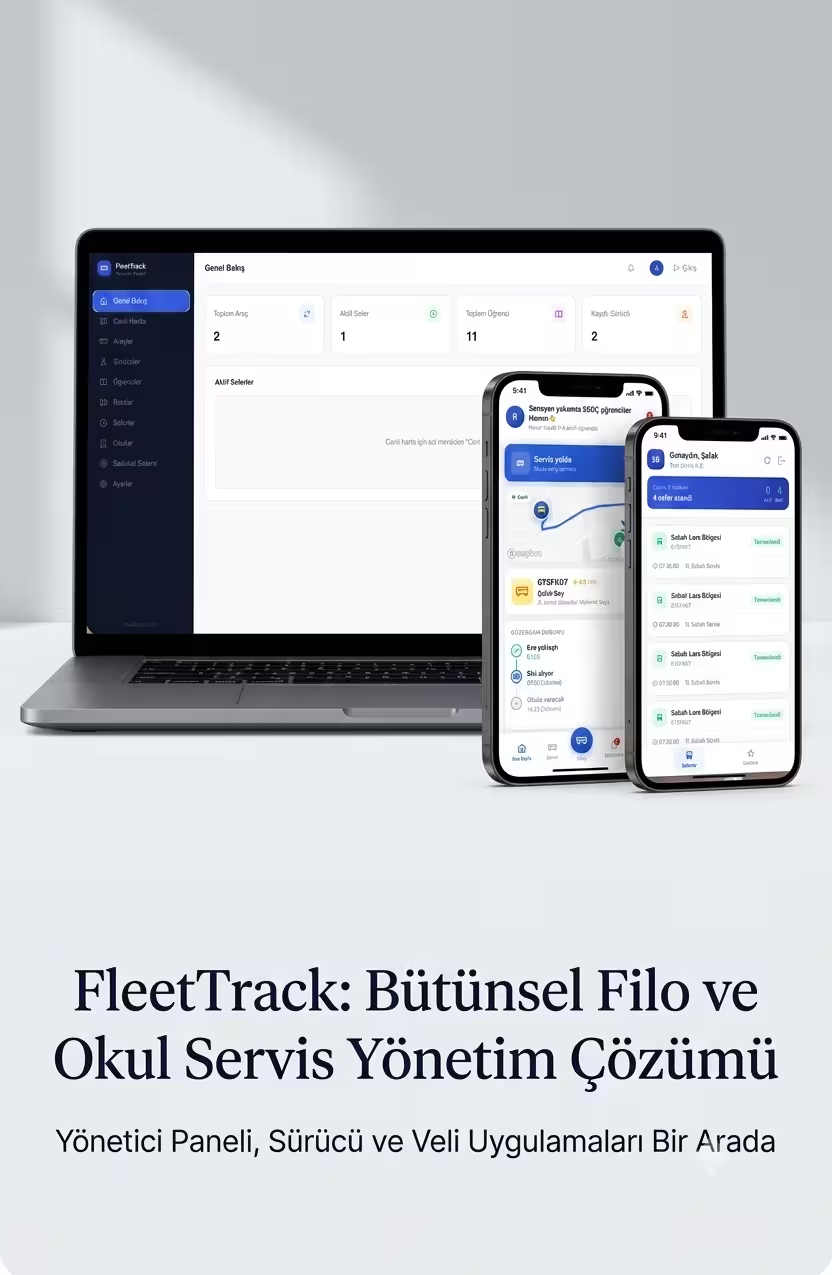
A school bus tracking system receives timestamped location data from a driver app or an installed GPS device and sends it to a secured server. The server associates each update with the correct vehicle, active route and authorised users. A parent app then shows only the permitted bus, its latest update time and defined stop or trip states. Rules on the server can trigger notifications for departure, approach or student boarding events. The product is more than a map: it needs role-based access, data minimisation, outage handling, audit records and an operations dashboard. Estimated arrival times depend on traffic and location freshness and should never be presented as a guaranteed arrival.
A mobile and web system that manages vehicle location, routes, stops, student-to-route relationships and notification events under one authorisation model, giving parents controlled visibility and operators a live operational view.
The core data flow
Tracking begins in the vehicle. With the necessary permission, a driver app receives coordinates and a timestamp from the device location service. Android asks developers to verify that background access is necessary and to explain its purpose clearly. If a user grants only approximate location, background accuracy remains approximate as well. Android background-location guide
The location packet is sent over an authenticated connection. The server checks whether it belongs to the expected vehicle, active trip and time window. Old, out-of-order or implausibly jumping points should be flagged before becoming the “current” location. Parents should see the last update time with the point so they do not mistake a frozen marker for live data.
How does information reach a parent?
An authorised view
A parent account should not query every vehicle directly. The server verifies the parent–student–route relationship and returns only that limited view. Administrator, operator, driver and parent roles require distinct permissions.
Events and notifications
Events such as “trip started,” “approaching a defined stop,” “student boarded” and “trip completed” are stored separately from raw coordinates. When a rule matches, the server can request a notification to the relevant devices. Firebase Cloud Messaging describes an architecture with a trusted server environment and Android, Apple or web clients. Firebase Cloud Messaging documentation
Notification delivery does not prove that a parent read the message. Current status and timestamps should remain available inside the app. Critical operations should not depend on push alone; dashboard alerts and a human contact path may also be required.
Routes and estimated arrival
A service can combine stop order, planned times and current position to estimate approach. Mapping services can calculate routes, distances and travel times.
ETA remains an estimate. Traffic models, GPS accuracy, update intervals, route deviations and network interruptions all affect it. The interface should label it as estimated and display freshness and uncertainty clearly.
Turkey’s KVKK principles require personal data to be processed for specified, explicit and legitimate purposes; remain relevant and proportionate to that purpose; and be retained only as long as needed. A school service should therefore define its purpose and retention policy instead of storing unlimited history “just in case.” KVKK publication on processing principles
Product boundary in the FleetTrack example
SolidSEO’s FleetTrack concept is organised around an operator view, a driver trip workflow and a controlled parent-tracking screen. It is not a guarantee of performance or legal compliance. A live deployment must separately assess the school’s processes, controller responsibilities, devices and field-test results.
What does this structure deliver?
Shows parents current trip state and data freshness in one view.
Turns approach and trip events into notifications that can reduce routine calls.
Separates administrator, driver and parent access through defined roles.
Makes route deviation, stale data and delay exceptions visible to operators.
Supports governance of location data through purpose, access and retention rules.
Screens and evidence from implementation
Options for collecting vehicle location
| Criterion | Driver phone | Installed GPS device | Hybrid model |
|---|---|---|---|
| Start-up | Fast pilot after app installation | Requires hardware, installation and connectivity | Pilot with phones and equip critical vehicles |
| Continuity | Depends on permission, battery and app state | Depends on vehicle power and device connection | Allows cross-checking when one source fails |
| Driver events | Can record boarding, drop-off and trip completion | Primarily provides raw location | Combines location with operational events |
| Cost pattern | Low hardware cost but requires device management | Hardware, installation and data costs | Phased investment according to need |
| Best fit | Small pilots and driver-interaction workflows | Stable fleets with a device standard | Operations needing both continuity and event input |
Short, clear answers
Does tracking work without internet access?+
Live sharing needs connectivity. A driver app can queue short-term updates and send them later with original timestamps. Parents must always see when data was last refreshed.
Should a parent see the vehicle all day?+
That is a product and data-governance decision. Access is commonly limited to the active trip, relevant route and authorised parent. The data controller must define purpose, legal basis and retention.
Why does an ETA change?+
Traffic, positioning accuracy, update intervals, deviations and network delay affect the estimate. Present ETA as a timestamped estimate, not a promise.
Does delivered push mean the message was read?+
No. Delivery, display and user action are different states. Keep critical status visible in the app and plan another contact path when operations require it.
Is a phone or GPS device better?+
It depends. Phones support fast pilots and driver input; installed units can suit stable fleets; a hybrid may fit operations that need both location continuity and workflow events.
Sources
Related guides
What Is the Difference Between GEO and SEO? A Practical Comparison
Compare the roles of SEO and GEO, where they overlap, and how to apply both within one reliable publishing workflow.
Read →AI Search and GEOHow Can a Business Appear in AI Search?
A practical checklist that helps business pages become eligible, understandable and verifiable for Google AI features and ChatGPT Search.
Read →FleetTrack and Mobile SystemsEssential Features of School Bus Software
Evaluate the mandatory features, second-phase options and risky design choices that separate an operational product from a simple map.
Read →