How to Choose a Parent School Bus Tracking App
Evaluate a parent bus-tracking app from demo to contract using security, freshness, operations and support criteria.
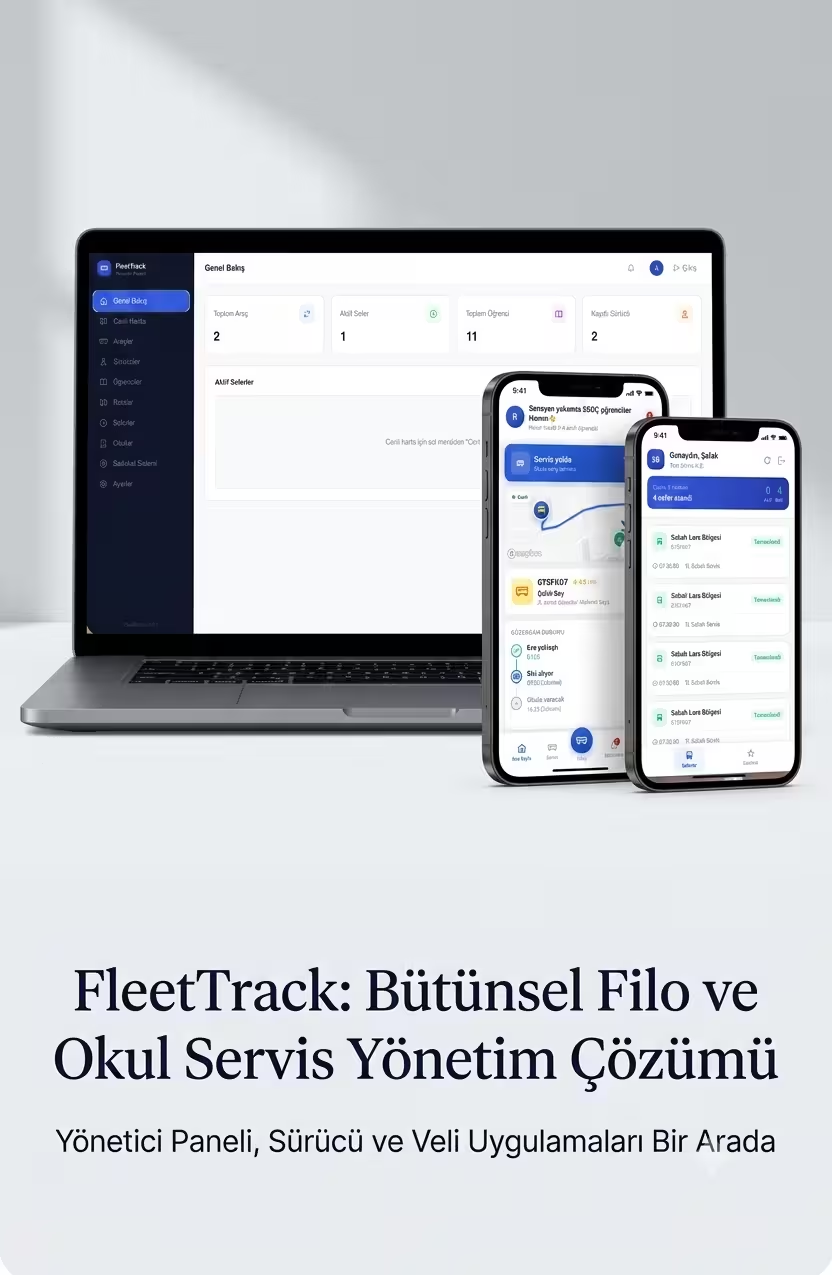
When choosing a parent school bus tracking app, look beyond the map design. Test the last-location timestamp, stale or incorrect-data behaviour, parent–student authorisation, notification rules, driver usability and the operator exception dashboard. Ask the supplier in writing which personal data is collected, why it is needed, where and how long it is retained, how it is deleted after account closure and who can access audit events. Run a pilot with a real vehicle, weak connectivity and different phone models. Eliminate products that present ETA as a certainty, expose multiple vehicles through shared links or leave support ownership undefined. Reliable core workflows matter more than the total feature count.
A selection criterion is a testable requirement that reveals whether the product can operate securely, clearly and sustainably in a real transport workflow. It should be verifiable through an acceptance scenario, not just marketing copy.
Document the use case first
How many vehicles, schools, routes, stops, drivers and parents are involved? Are routes stable or frequently changed? Is boarding confirmation required? Will the school or transport company operate the system? Without these answers, packaged and custom solutions cannot be compared fairly.
What must be tested in the demo?
Data freshness
The map marker should show the last update time. Disable network access and observe how the app labels the old point. A “live” label should mean updates are still arriving.
Authorisation
Ask for a test account that tries to access another route or student. Access must be checked on the server. Review password security, account recovery, sign-out and staff offboarding. OWASP recommends logging and monitoring authentication failures and account lockouts. OWASP Authentication Cheat Sheet
Location-permission experience
The driver app should explain why and when it uses location. Android treats background access as a separate permission journey and lets the user decline. Apple also provides explicit location-service authorisation tied to purpose descriptions. Android location permissions Apple Core Location authorisation
Notification correctness
How is an approach zone calculated? Can one event be generated twice? If push fails, is in-app state still current? In FCM’s architecture, a trusted server produces messages for client apps; the supplier should explain how device tokens and delivery failures are handled. Firebase Cloud Messaging
Operations and support
Who is alerted if the driver does not start a trip, the vehicle changes, a route is edited or location disappears? The operator view should include an exception queue, search and event history. Support hours, escalation paths, backup and data export should be written into the service agreement.
Data and contract review
KVKK principles require data to be relevant, limited and proportionate and retained only as long as needed. Clarify controller and processor roles, subprocessors, retention and deletion, incident notice and end-of-contract export with legal counsel. KVKK principles
Pilot acceptance plan
- Select one primary and one backup vehicle for a week.
- Test driver and parent flows on different Android and iPhone models.
- Simulate network loss, denied location permission, late departure and vehicle replacement.
- Record incorrect, duplicate and late notifications by event.
- Measure the support response and resolution path.
- Do not roll out to the fleet until mandatory pilot defects are closed.
Packaged or custom development?
A packaged product may offer a faster start and a known process. Custom development fits unique roles, integrations and brand experience. White-label software sits between them. Compare data portability, integration limits, update ownership and total operating load alongside the initial price.
What does this structure deliver?
Tests a marketing demo against real field and failure scenarios.
Separates location freshness from the appearance of the map.
Moves authorisation, data lifecycle and support ownership into the contract.
Validates the experience across devices and connectivity conditions.
Compares packaged, white-label and custom models against the same criteria.
Screens and evidence from implementation
Compare delivery models
| Criterion | Packaged SaaS | White label | Custom development |
|---|---|---|---|
| Time to start | Usually fastest | Medium with brand configuration | Longer analysis and build phase |
| Process fit | Standard product workflows | Limited configuration | Business-specific workflows can be designed |
| Integration | Limited to offered APIs and add-ons | Depends on provider scope | Designed within technical scope and budget |
| Control | Roadmap belongs to provider | Brand control with provider-owned core | Code, infrastructure and maintenance defined by contract |
| Operating load | Provider-led | Shared | Owned by the business or service provider according to model |
Short, clear answers
Is a free demo enough?+
No. A demo shows the happy path. Acceptance needs a limited pilot in a real vehicle, weak connectivity, multiple devices and failure scenarios.
Can an ETA accuracy guarantee be required?+
A measurement method and service target can be defined, but absolute accuracy is unrealistic because traffic and data outages are external factors. The interface should clearly label estimates and freshness.
Is a shared tracking link secure?+
A permanent link that can be forwarded creates access risk. If links are needed, design them with short validity, limited scope and revocation; parent accounts should remain strongly authorised.
Can data be moved to another platform?+
It depends on the supplier. Define in writing how users, routes, events and necessary history will be exported and delivered at contract end.
Is the product with the most features best?+
No. Reliable trip flows, clear authorisation, honest failure states and sustainable support are more valuable than unused feature count.
Sources
Related guides
What Is the Difference Between GEO and SEO? A Practical Comparison
Compare the roles of SEO and GEO, where they overlap, and how to apply both within one reliable publishing workflow.
Read →AI Search and GEOHow Can a Business Appear in AI Search?
A practical checklist that helps business pages become eligible, understandable and verifiable for Google AI features and ChatGPT Search.
Read →FleetTrack and Mobile SystemsHow Does a School Bus Tracking System Work?
Understand the data flow, operational limits and implementation steps from vehicle location to parent notifications.
Read →