Reservation Tracking Systems for Transfer Companies
Manage transfer requests from quotation through driver assignment, flight and payment state, pickup and completion in one operations workflow.
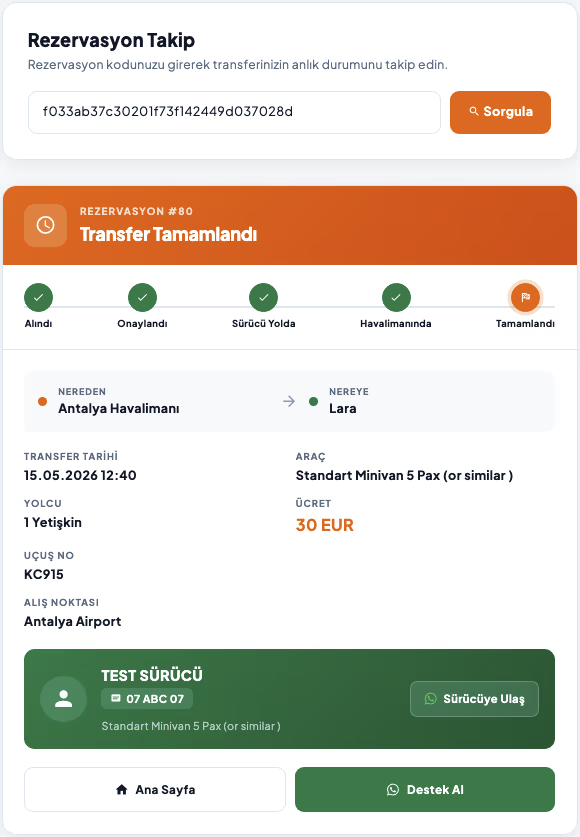
A transfer reservation tracking system brings requests from web forms, calls, agencies and WhatsApp under one reservation number. It manages explicit states such as new, awaiting information, quoted, confirmed, awaiting payment, vehicle and driver assigned, passenger collected, completed or cancelled. Each record contains local date and time zone, pickup and drop-off, passenger and luggage requirements, flight number, price scope, payment state, assigned vehicle and driver, and change history. The system should check capacity conflicts and duplicate requests and notify customers only with verified information. WhatsApp, route services and analytics may be integrated, but the central operations record must remain the single source of truth for the booking.
A system that standardises transfer requests from multiple sales and communication channels and manages availability, pricing, payment, vehicle and driver assignment, customer messaging and operational history through one booking identity.
Separate a reservation from a message
A WhatsApp chat, email or form submission is not itself a reservation; it is a request to create one. The system generates a unique record after required fields and business rules are validated. A duplicate form submission or retried webhook must not create a second booking.
Core data model
Time and route
Store date, local time and time zone explicitly. Pickup and drop-off can include a validated address or place ID alongside human instructions. Google Routes API calculates routes, distance and duration between points and route matrices across multiple origins and destinations. These are planning inputs; actual travel time depends on traffic and field conditions. Google Routes API
Passenger and service scope
Collect the primary contact, passenger count, luggage and service-relevant needs such as child seats or accessibility. Do not request unnecessary identity details. KVKK principles require data to be processed for specified purposes, remain limited and proportionate and be retained only as needed. KVKK principles
Price and payment
Record currency and whether tax, waiting, tolls, parking, night service or add-ons are included. Store the provider transaction ID, not card data. Refund and partial payment should be separate events.
Assignment and capacity
Check vehicle class, seat and luggage capacity, driver availability and repositioning time between jobs. Prevent overlapping assignment, or require an explicit managerial override with a reason.
Recommended state workflow
- New request: Received but not validated.
- Awaiting information: A required field or pricing input is missing.
- Quote sent: Scope and price were delivered.
- Confirmed: Customer approval is recorded.
- Awaiting payment / paid: Financial state remains separate from operations.
- Assigned: Vehicle and driver are confirmed.
- Passenger collected: Driver confirmed the pickup event.
- Completed: Drop-off and closure are recorded.
- Cancelled: Who cancelled, when and under which rule is known.
Store each transition with the authorised user, timestamp and old/new values. OWASP recommends application logging with enough context to investigate security and operational events. OWASP Logging Cheat Sheet
Channel integrations
Meta Cloud API can send messages, while Webhooks receive inbound and status events. Confirmation, driver or vehicle information and important changes should be generated from core reservation state. Message delivery does not mean the transfer was completed. Meta WhatsApp Business Platform
Website and agencies
Connect every channel to the same required fields and validation. An agency can access its own bookings, but never another agency’s customer or price data. Store channel and campaign attribution when it is needed for reporting.
Analytics and conversion
Send confirmation or payment events only after the real business event occurs. Google Analytics 4 ecommerce documentation shows a purchase event with a unique `transaction_id`, currency, value and item data. Preserving one transaction identifier helps reduce duplicate counting. GA4 ecommerce measurement
Pilot and acceptance tests
Test short and long transfers, return trips, flight delay, night tariff, vehicle change, extra stop, cancellation and partial payment. Submit the same request twice, assign an overlapping driver, attempt access through the wrong agency account and force messaging failure. The system should state what is unknown and give operators a correction path.
SolidSEO projectsct example
The airport-to-hotel transfer projectsct combines web reservations, destination pages, rapid contact and operational visibility. The transfer-tracking visual demonstrates booking states and task assignment. A production build must be adapted during discovery to each company’s tariff, fleet, agency, payment and data responsibilities.
What does this structure deliver?
Unifies requests from different channels under one reservation identity.
Reduces duplicate records and vehicle or driver capacity conflicts.
Separates pricing, payment and operational state clearly.
Limits customer, agency, driver and manager access by role.
Creates measurable event history from source to completion.
Screens and evidence from implementation
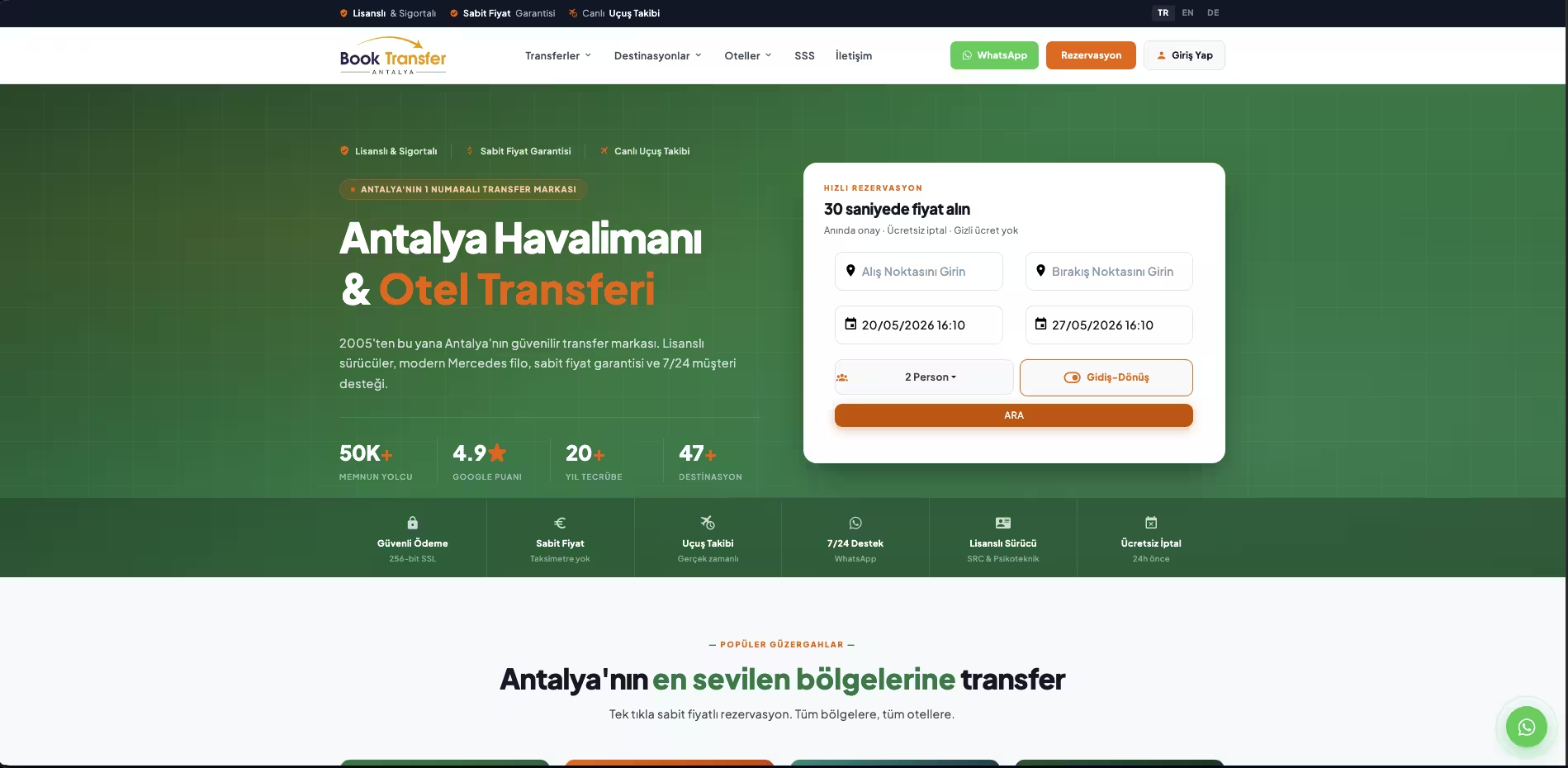
Compare transfer reservation management options
| Criterion | Spreadsheet | WhatsApp-led | Central reservation system |
|---|---|---|---|
| Multiple channels | Copied manually | Scattered across chats | Forms, agencies and messages converge |
| Conflict checks | Formulas and human review | Manual | Vehicle/driver time and capacity rules |
| State history | Depends on cell edits | Conversation history | Authorised state events |
| Customer updates | Manual | Fast but disconnected from record | Controlled from reservation state |
| Reporting | Requires preparation discipline | Limited | By channel, route, state, cancellation and conversion |
| Access | Can expand through file sharing | Phone and group membership | Role and record scope |
Short, clear answers
Can flight delays be monitored automatically?+
A flight-data provider can supply status. Explain its coverage and delay, verify critical changes operationally and manage their effect on assignment.
Can one vehicle serve two reservations?+
Yes if times do not overlap and repositioning time is sufficient. Evaluate buffer and route time, not only stated booking times.
Can WhatsApp be the primary reservation record?+
It can be an intake channel, but changes, payment, assignment and closure need a central record. Conversation state alone does not ensure operational accuracy.
What should an agency be able to see?+
Only bookings, passenger and price information within its authorised scope. Enforce organisation, role and record-level access on the server.
When should a conversion be counted?+
Count it at confirmation or successful payment according to the business definition, after the core system event. Treating a form submission as a guaranteed booking can misstate results.
Sources
Related guides
What Is the Difference Between GEO and SEO? A Practical Comparison
Compare the roles of SEO and GEO, where they overlap, and how to apply both within one reliable publishing workflow.
Read →AI Search and GEOHow Can a Business Appear in AI Search?
A practical checklist that helps business pages become eligible, understandable and verifiable for Google AI features and ChatGPT Search.
Read →FleetTrack and Mobile SystemsHow Does a School Bus Tracking System Work?
Understand the data flow, operational limits and implementation steps from vehicle location to parent notifications.
Read →